As written.
Note A.—Page 674.
The particular function whose integral the Difference Engine was constructed to tabulate, is
Δ7uz = 0.
The purpose which that engine has been specially intended and adapted to fulfil, is the computation of nautical and astronomical tables. The integral of Δ7uz = 0 being uz = a + bx + cx2 + dx3 + ex4 + fx5 + gx6, the constants a, b, c, &c. are represented on the seven columns of discs, of which the engine consists. It can therefore tabulate accurately and to an unlimited extent, all series whose general term is comprised in the above formula; and it can also tabulate approximatively between intervals of greater or less extent, all other series which are capable of tabulation by the Method of Differences.
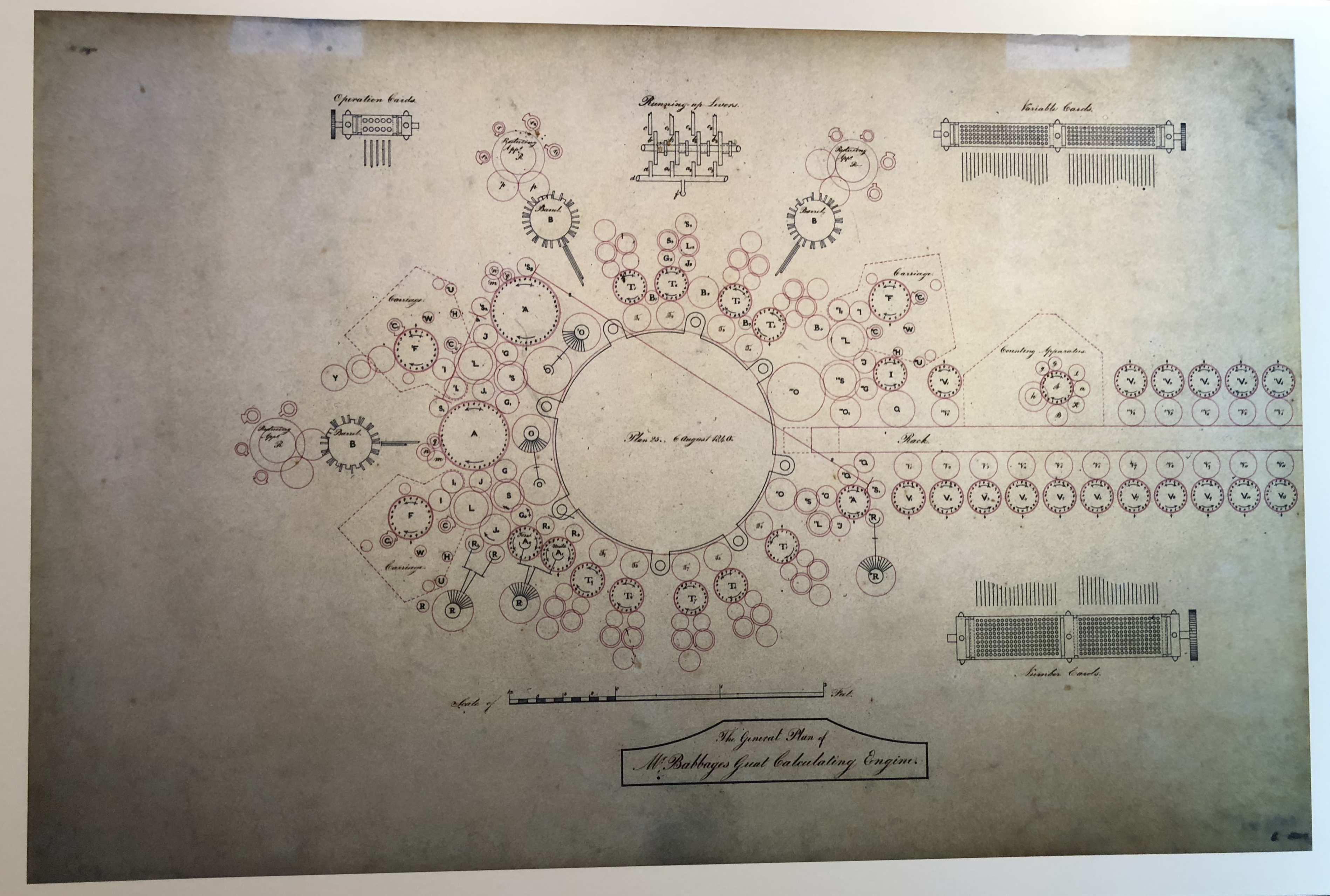
The Analytical Engine, on the contrary, is not merely adapted for tabulating the results of one particular function and of no other, but for developing and tabulating any function whatever. In fact the engine may be described as being the material expression of any indefinite function of any degree of generality and complexity, such as for instance,
F( x, y, z, logx, siny, xp, &c.),
which is, it will be observed, a function of all other possible functions of any number of quantities.
The operating mechanism can even be thrown into action independently of any object to operate upon (although of course no result could then be developed). Again, it might act upon other things besides number, were objects found whose mutual fundamental relations could be expressed by those of the abstract science of operations, and which should be also susceptible of adaptations to the action of the operating notation and mechanism of the engine. Supposing, for instance, that the fundamental relations of pitched sounds in the science of harmony and of musical composition were susceptible of such expression and adaptations, the engine might compose elaborate and scientific pieces of music of any degree of complexity or extent.
The distinctive characteristic of the Analytical Engine, and that which has rendered it possible to endow mechanism with such extensive faculties as bid fair to make this engine the executive right-hand of abstract algebra, is the introduction into it of the principle which Jacquard devised for regulating, by means of punched cards, the most complicated patterns in the fabrication of brocaded stuffs. It is in this that the distinction between the two engines lies. Nothing of the sort exists in the Difference Engine. We may say most aptly that the Analytical Engine weaves algebraical patterns just as the Jacquard-loom weaves flowers and leaves. Here, it seems to us, resides much more of originality than the Difference Engine can be fairly entitled to claim. We do not wish to deny to this latter all such claims. We believe that it is the only proposal or attempt ever made to construct a calculating machine founded on the principle of successive orders of differences, and capable of printing off its own results; and that this engine surpasses its predecessors, both in the extent of the calculations which it can perform, in the facility, certainty and accuracy with which it can effect them, and in the absence of all necessity for the intervention of human intelligence during the performance of its calculations. Its nature is, however, limited to the strictly arithmetical, and it is far from being the first or only scheme for constructing arithmetical calculating machines with more or less of success.
The Analytical Engine has no pretensions whatever to originate any thing. It can do whatever we know how to order it to perform. It can follow analysis; but it has no power of anticipating any analytical relations or truths. Its province is to assist us in making available what we are already acquainted with. This it is calculated to effect primarily and chiefly of course, through its executive faculties; but it is likely to exert an indirect and reciprocal influence on science itself in another manner. For, in so distributing and combining the truths and the formulæ of analysis, that they may become most easily and rapidly amenable to the mechanical combinations of the engine, the relations and the nature of many subjects in that science are necessarily thrown into new lights, and more profoundly investigated. This is a decidedly indirect, and a somewhat speculative, consequence of such an invention. It is however pretty evident, on general principles, that in devising for Mathematical truths a new form in which to record and throw themselves out for actual use, views are likely to be induced, which should again react on the more theoretical phase of the subject. There are in all extensions of human power, or additions to human knowledge, various collateral influences, besides the main and primary object attained.
Diagram for the computation by the Engine of the Numbers of Bernoulli. See Note G. (page 722 et seq.)
- Number of Operation.
- Nature of Operation.
- Variables acted upon.
- Variables receiving results.
- Indication of change in the value on any Variable.
- Statement of Results.
- Data.
- Working Variables.
- Result Variables.
Note G
Diagram for the computation by the Engine of the Numbers of Bernoulli. See Note G. (page 722 et seq.)
Number of Operation.
Nature of Operation.
Variables acted upon.
Variables receiving results.
Indication of change in the value on any Variable.
Statement of Results.
Data.
Working Variables.
Result Variables.